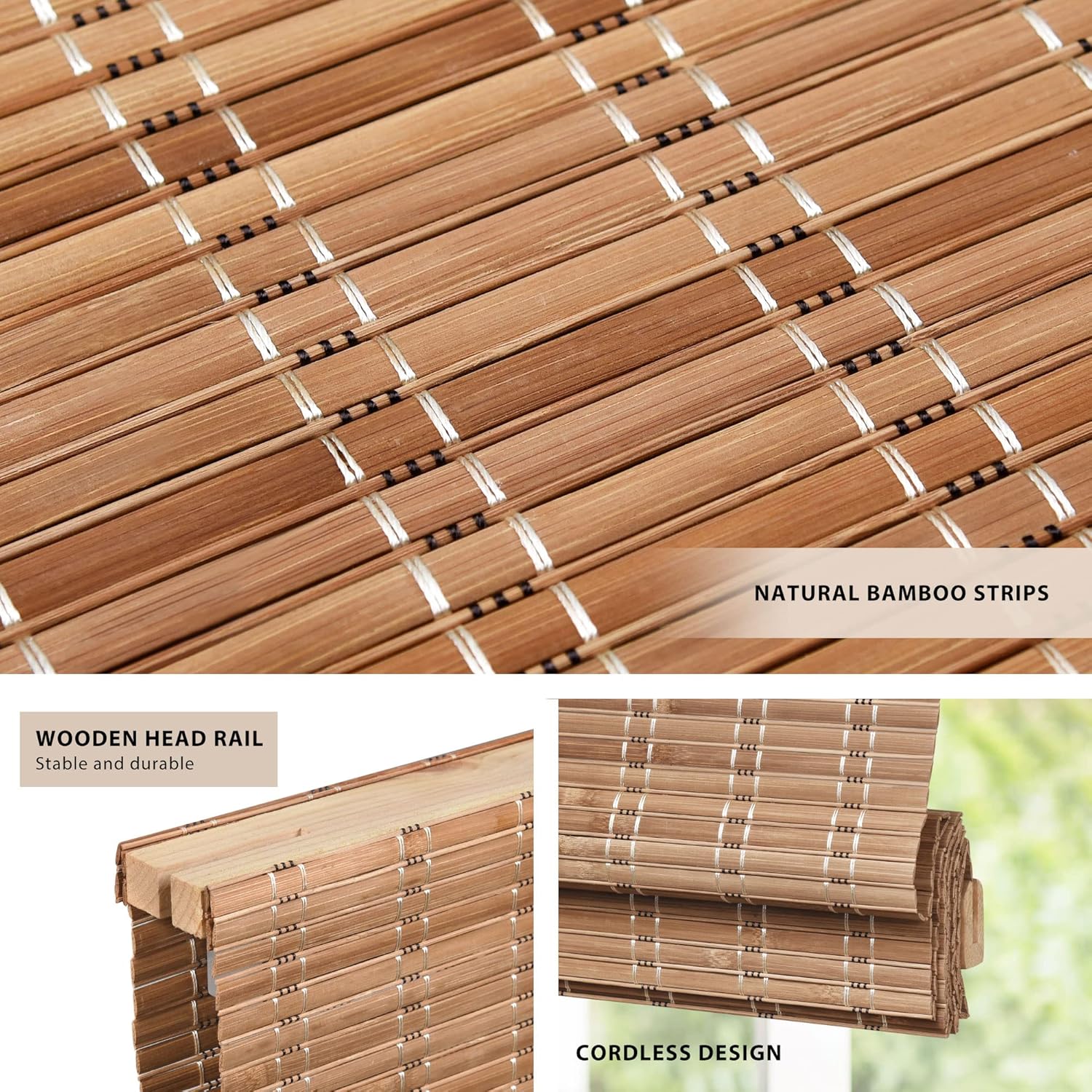
Bamboo shades — the woven, honey-toned window coverings you’ve seen in every sun-drenched living room mood board — are one of the fastest ways to bring organic warmth into a rental apartment. But if your lease has a “no holes in the walls” clause (and most standard leases do), the usual installation playbook is off the table. That’s where no-drill mounting comes in: hardware systems that grip window frames, use removable adhesive strips, or tension inside the window opening itself — no studs, no anchors, no patching required when you move out. This guide walks you through every viable no-drill method, the real weight and sizing constraints you need to respect, which bamboo shade formats actually work without drilling, and the decision rules to pick the right combo for your specific window. By the end, you’ll have a clear framework rather than a shopping list you’ll second-guess.
Why Bamboo Shades and No-Drill Hardware Are an Awkward Pairing — and How to Make Them Work
Here’s the honest tension: bamboo and woven-wood shades are heavier than fabric roller shades. A standard matchstick bamboo roll-up in a 36-inch width typically runs 2–4 lbs depending on slat density and dowel hardware. Flat-weave woven shades with a cord-and-pulley lift system can push toward 5–6 lbs on wider spans. No-drill solutions, meanwhile, have hard weight ceilings — and if you ignore those, the shade pulls loose at 2 a.m. and takes a chunk of your window casing with it.
The Spruce’s guide on drill-free window treatments identifies three categories of no-drill hardware, each with distinct weight tolerances:
-
Tension-mount systems — a spring-loaded rod or bracket that presses outward against the inside faces of the window frame. No adhesive, completely removable. Weight limits typically 8–15 lbs depending on the brand; suited for inside-mount (meaning the shade sits inside the window opening rather than in front of it on the wall).
-
Adhesive-strip brackets — peel-and-stick mounting blocks (Command-style strips being the most recognized format) that bond to the window frame or wall surface. Bob Vila’s weight-limit guide rates standard adhesive strips for 1–5 lbs per strip pair on smooth painted drywall; textured or plaster walls reduce that rating substantially. Two to four pairs are typically used per shade, giving a practical ceiling of 4–15 lbs — but that ceiling drops fast on older plaster walls common in pre-war buildings.
-
Magnetic systems — two-part brackets where one piece attaches to the window frame and the other stays on the shade. Rarely rated above 5 lbs; best suited for light matchstick shades on metal-framed windows (more common in lofts and industrial apartments).
The practitioner takeaway: before you choose a shade, weigh it. Most major retailers including Blinds.com list shade weights in their product specs. Pull that number first, then match it to your hardware option. Getting this backwards — falling in love with a woven roman shade and then discovering it’s 7 lbs on a window where you only have adhesive strips — costs you a return shipping label.
The Bamboo Shade Formats That Play Best Without Drilling
Not every bamboo window treatment is equally no-drill-friendly. Here’s how the main formats stack up on the two criteria that matter most for renters: weight and inside-mount compatibility.
Matchstick Roll-Up Shades
The lightest format in the bamboo family. Thin-diameter bamboo reeds (typically 3–5mm) woven on cotton cord, rolled up by hand or with a simple pull cord. Apartment Therapy’s renter window treatment coverage consistently flags these as the most accessible no-drill option because they’re lightweight (often under 3 lbs at 36 inches wide), inexpensive (most fall in the $25–$75 range), and available in inside-mount configurations with a slim mounting rail that tension hardware can grip easily.
Trade-off: Matchstick shades have visible light gaps between reeds and around the perimeter. If privacy is a primary need — ground floor, street-facing window — they work better layered behind a sheer curtain panel on a tension rod.
Flat-Weave Woven Wood Shades
A step up in material density: tighter weave, often mixing grasses, jute, or bamboo strips. More design character, better light diffusion, but noticeably heavier. These are the shades you see in designer installations, and they’re the format where no-drill mounting becomes a real constraint. At 48 inches wide and above, weights routinely exceed adhesive-strip safe limits on smooth drywall. Tension-mount systems are viable if the window frame is structurally sound; adhesive strips are risky at this width.
Bamboo Roman Shades
The most complex and typically heaviest format: a flat panel that folds up in horizontal pleats via a lift cord mechanism, with a headrail, cord locks, and fabric backing. On wider windows (42 inches+), these can approach 5–8 lbs. Roman shades almost always require a headrail mount — and that headrail needs to attach to something with structural grip. Tension-mount systems built specifically for roman shade headrails exist (several retailers offer them), but reviewers on Houzz’s no-drill forum consistently note that roman shades above 42 inches wide are where the no-drill constraint starts feeling genuinely limiting. Below 36 inches, purpose-built tension brackets handle them cleanly.
By the Numbers
| Shade Format | Typical Weight (36” wide) | Best No-Drill Method | Practical Width Ceiling |
|---|---|---|---|
| Matchstick roll-up | 1.5 – 3 lbs | Tension rod or adhesive brackets | 72” (verify bracket count) |
| Flat-weave woven | 3 – 5 lbs | Tension-mount brackets | 48” |
| Bamboo roman shade | 4 – 7 lbs | Tension headrail system | 36” |
Sizing Decisions That Determine Whether This Works
Sizing a no-drill bamboo shade isn’t just about measuring width and height — the mounting method changes which measurement matters most.
Inside mount (shade sits inside the window opening): You need a minimum frame depth — typically 1.5 to 2 inches — for the tension bracket or adhesive block to have a gripping surface. Most double-hung windows in apartments meet this threshold, but shallow aluminum-framed windows in newer construction sometimes don’t. Blinds.com’s shade specification pages list minimum inside-mount depth requirements per product; check this before ordering. For inside-mount sizing, measure the width at three points (top, middle, bottom) and use the narrowest measurement. Deduct ¼ inch for clearance. Height is measured from top of opening to sill.
Outside mount (shade mounts above and outside the window opening): This is where adhesive strips attach to the wall surface rather than the window frame. You get better light blockage at the perimeter, can make a small window read larger, and you’re not constrained by frame depth. The trade-off: you’re now bonding to drywall or plaster, which has its own adhesion limits and risks. Bob Vila’s adhesive strip guide recommends a minimum 72-hour cure time before loading the brackets with weight, and notes that strips should never be applied over paint that is peeling, textured, or less than 7 days old.
The sizing decision rule:
- If your window frame has 2+ inches of depth and the shade is under 5 lbs → inside mount with tension brackets, cleanest result.
- If your frame is shallow or you want coverage beyond the opening → outside mount with adhesive strips, but respect the weight limits and do a test strip 48 hours before committing.
- If neither works cleanly (plaster walls, metal frames, overweight shade) → a tension curtain rod with clip rings and a lighter matchstick panel is the practical fallback that Apartment Therapy writers return to repeatedly for exactly this reason.
The Security Deposit Math You Should Actually Run
The intuitive fear — that any window treatment installation risks the deposit — is real but overstated when you use the right hardware correctly. The actual risk landscape looks like this:
Tension mounts: Zero wall contact. Zero deposit risk from the mounting hardware itself. The only failure mode is a shade that’s too heavy torquing the window frame trim — which is why respecting weight limits matters.
Adhesive strips (properly applied and removed): 3M Command-type strips, removed per manufacturer instructions (slow 45-degree pull rather than yanking), leave painted drywall intact in the overwhelming majority of cases, per Bob Vila’s removal guide. The caveat: fresh paint (less than 30 days old) or matte/flat finishes are more vulnerable. If you moved into a freshly painted apartment, wait a month or accept the small risk.
Adhesive strips (removed wrong or overloaded): Paint pulls. Drywall paper tears. Repair costs at move-out typically run $50–$150 per patch depending on market, per landlord estimates aggregated in Apartment Therapy’s renter guides. If your deposit is $2,000 and you’re hanging a $45 shade, the asymmetry is worth thinking about — one careless strip removal can cost more than the shade itself.
The practitioner decision frame: Run the replacement cost of the wall repair against the deposit at risk and the cost of the shade. If you’re in a high-deposit market (NYC, SF, Boston) with a deposit of $3,000+, a $20 tension-mount bracket investment to avoid adhesive entirely is an obvious call. If you’re in a mid-market city with a $600 deposit and smooth drywall, Command-strip mounting on a 3-lb matchstick shade is well within the acceptable risk envelope.
If X, Then Y: Your Decision Rules in Plain English
After working through all the variables, here’s the framework:
- If your window frame has 1.5”+ depth and your shade weighs under 5 lbs → inside-mount tension brackets. No deposit risk, fully reversible, clean look.
- If your shade is under 3 lbs and you need outside-mount coverage → adhesive strip brackets on smooth painted drywall, 48-hour cure, remove per manufacturer instructions. Low risk.
- If your shade is 5+ lbs or your walls are plaster/textured → go lighter. Switch to a matchstick roll-up under 3 lbs, or use a tension curtain rod with a bamboo-print or woven fabric panel as a visual substitute. Don’t force a heavy shade onto hardware it’ll eventually defeat.
- If you have metal window frames → magnetic bracket systems are worth researching; they’re the underused option that solves metal-frame apartments cleanly.
- If privacy is the priority over aesthetics → layer a $25 matchstick shade on a tension rod with a $15 sheer on a second tension rod. The combination handles both light control and privacy without a single screw.
The deposit-safe bamboo window is absolutely achievable in 2026 — the hardware ecosystem has matured enough that inside-mount tension systems and properly rated adhesive brackets cover the majority of apartment window scenarios. The discipline is just weighing the shade before you fall for it, not after.