Woven bamboo shades — the kind made from natural reeds, grasses, and jute woven into an open lattice — are one of the most requested window treatments in bedrooms right now, and it’s easy to see why. They bring a warm, organic texture to a room that no synthetic blind can replicate. But here’s the tension every buyer eventually hits: woven wood shades are, by their fundamental construction, designed to filter light, not block it. Those tiny gaps between fibers that make them glow so beautifully at golden hour are the same gaps that let streetlights, car headlights, and an early sunrise straight into your pillow zone at 5 a.m. If you’re measuring your sleep environment seriously — or helping a client build one — that distinction matters enormously. This guide explains what “blackout” actually means in the context of woven woods, which product configurations and add-on systems come closest to delivering it, where the honest compromises live, and how to make the right call for your specific situation.
| EDITOR'S PICK[Blackout Bamboo Roman Shades Co…](https://www.amazon.com/dp/B08GCBF42J?tag=greenflower20-20) | Mid-tier[LUCKUP Cordless Bamboo Roman Bl…](https://www.amazon.com/dp/B0CZ38SX8Z?tag=greenflower20-20) | Budget pick[Comzone Cordless Blackout Bambo…](https://www.amazon.com/dp/B0CQT39MTJ?tag=greenflower20-20) | |
|---|---|---|---|
| Valance | — | ✓ | — |
| Material | Woven Wood | Bamboo | Woven Wood |
| Usage | Windows, Doors | Indoor Windows | Home, Office, Doors |
| Price | $55.99 | $43.99 | $34.99 |
| See on Amazon → | See on Amazon → | See on Amazon → |
Why “Blackout Bamboo” Is a Marketing Gray Zone
Let’s start with the terminology problem, because it shapes every decision downstream.
In the window treatment industry, blackout is a specific performance classification. A true blackout lining — typically a heavy, opaque fabric or foam-backed material — blocks 99 to 100 percent of incoming light as measured under standardized testing conditions. Products rated to this spec are commonly used in hotel rooms, nurseries, and home theaters. The Sleep Foundation’s overview of light and sleep notes that even low levels of ambient light during sleep can suppress melatonin and affect sleep-cycle quality, which is why sleep scientists treat true light elimination as the functional target.
Woven wood (also called woven bamboo, natural shades, or bamboo blinds depending on the retailer) is a material category defined by interwoven natural fibers. The density of the weave varies — tight flat-reed styles like matchstick bamboo pass less light; looser grasscloth or open rattan weaves pass dramatically more — but no woven-wood shade in its natural form reaches true blackout performance. The fibers themselves are semi-translucent in some cases, and even the tightest woven pattern leaves micro-gaps.
When retailers use phrases like “room darkening” or “blackout available,” they are almost always referring to a liner system added behind the woven wood face, not to the shade itself. Understanding that distinction is the first decision gate.
The Three Configuration Options — and What Each Actually Delivers
Once you accept that the blackout performance comes from a liner, not the bamboo, the market simplifies into three practical configurations.
Option 1: Unlined woven wood shade This is the base product. Light filtration (meaning it softens and diffuses sunlight without meaningfully reducing it) is the best description. Privacy during daylight is moderate; at night with interior lights on, silhouettes are visible from outside. Appropriate for living rooms, kitchens, and spaces where glare control — not darkness — is the goal. Not appropriate for sleep-sensitive bedrooms.
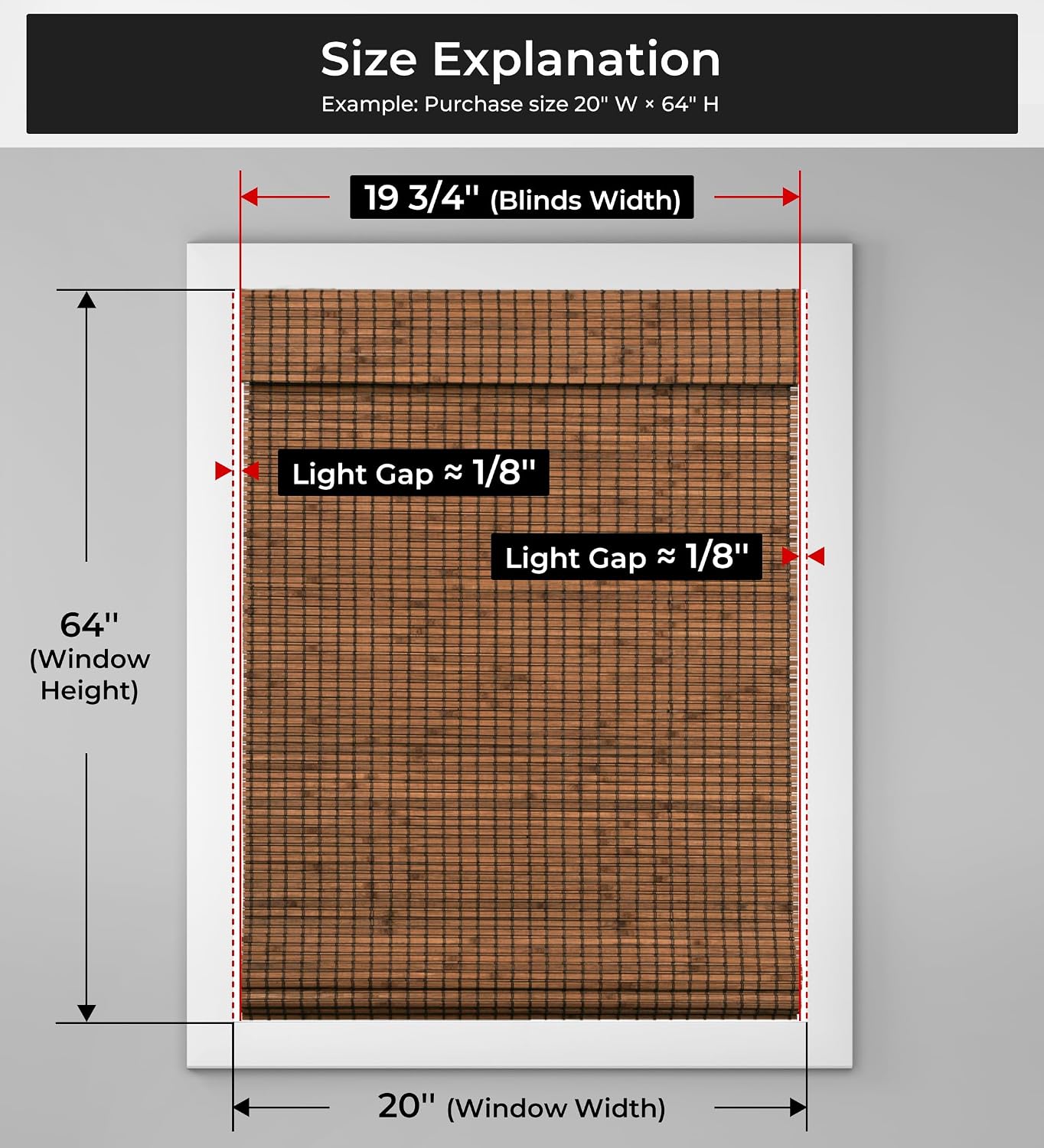
Option 2: Woven wood shade with room-darkening liner The most common “upgrade” option at every retailer tier. A room-darkening liner (typically a white or off-white opaque fabric panel) hangs behind the woven face, attached at the top rail or sewn in depending on the construction method. Room-darkening liners typically block 85–95 percent of light per manufacturer ratings. The Spruce’s buying guide for blackout shades notes that room-darkening products occupy the performance gap between filtered light and true blackout — they eliminate the “bright glow” effect but usually leave light bleed at the edges, especially on inside-mount installations. For most adult sleepers in moderately light-polluted environments, this configuration is sufficient. For shift workers, infants, or anyone managing a sleep disorder, edge bleed becomes a real problem.
Option 3: Woven wood shade with blackout liner, outside mount, with side channels This is the configuration that approaches real blackout performance. A true blackout liner (foam-backed or dual-opaque fabric) is paired with an outside mount — meaning the hardware attaches to the wall above and outside the window frame rather than inside the recess — which allows the shade to extend several inches beyond the frame on all sides, covering the light-bleed zones. Adding side channels (plastic or aluminum tracks that run vertically along the edges) closes the remaining gap between the liner edge and the wall. Apartment Therapy’s feature on woven wood shades and light control specifically calls out the outside mount + side channel combination as the closest a woven-wood window treatment can get to true room darkness.
The trade-off: outside mounts and side channels are visible. They frame the window in hardware rather than letting the shade appear to float within the frame. For design-forward installations where the architecture of the window is part of the room’s appeal, this can feel like a compromise. Whether it’s an acceptable one is a judgment call that depends on the room.
By the Numbers
| Configuration | Approximate Light Block | Edge Bleed | Starting Price (36”×72” shade) |
|---|---|---|---|
| Unlined woven wood | 10–30% | High | $45–$120 |
| Room-darkening liner added | 85–95% | Moderate | $120–$350 |
| Blackout liner + outside mount + side channels | 95–99% | Low–minimal | $250–$600+ |
Prices reflect mid-2026 retail across SelectBlinds, Blinds.com, and The Shade Store standard tiers. Custom sizing and motorization add materially to the upper end.
The Weave Density Variable — It Matters More Than Most Buyers Realize
Not all woven bamboo faces perform equally behind a liner. Weave density affects how much light slips through the face fabric above and around the liner attachment points, and it affects the visual aesthetics of the lined product.
Tighter weaves — flat matchstick bamboo, flat reed, and close-woven jute — tend to hold their appearance better when paired with a liner because the liner is less visible through the face. They also minimize the “halo” effect at the top of the shade where the liner may not extend fully to the header.
Looser, open weaves — open-pattern rattan, chunky grasscloth, or large-pattern woven grass — are more problematic. The liner becomes partially visible as a contrasting layer behind the face (especially in side-lit rooms), and light can leak through the open portions of the face above or around the liner. Bob Vila’s roundup of blackout shades flags this specifically: with open-weave naturals, the visual integrity of the window treatment can suffer when a blackout liner is added, because the two materials read as mismatched layers rather than a unified product.
If sleep performance is the primary objective, tighter weave constructions are the correct starting point. Matchstick bamboo and flat-reed styles from retailers including The Shade Store, Smith & Noble, and SelectBlinds offer the best foundation for lined blackout configurations.
Layering: The Designer’s Answer to the Performance Gap
Architectural Digest’s guide on layering window treatments for better sleep describes a strategy that design-forward buyers increasingly use: accept the woven shade’s light-filtration limitations and pair it with a second treatment — typically a blackout drapery panel hung on a separate rod outside the shade — that does the blackout work.
This approach has real advantages. The woven shade handles privacy, texture, and daytime softening. The drapery panel, closed at night, handles sleep performance. The combination also introduces warmth, layering depth, and acoustic absorption that a single shade can’t provide. The visible hardware count goes up, and the cost is higher (two treatment systems per window), but for spaces where the window itself is a design feature, this is often the most aesthetically honest solution.
The practical decision rule: if you’re working with a wide window or architectural feature window where outside mount hardware would be conspicuous, layering a blackout drapery behind or over a woven shade is frequently the better path. For standard bedroom windows in apartments or modest footprints, the outside-mount lined shade with side channels is typically more cost-efficient and simpler to operate.
Motorization and Blackout: A Note for Higher-Budget Installations
At the $600–$2,500+ tier — custom motorized installations through Smith & Noble, The Shade Store’s motorization program, or Blinds.com’s premium tier — motorization introduces one additional blackout consideration that’s easy to miss.
Motorized woven-wood shades use a roller or Roman fold mechanism housed in a fascia or cassette at the top of the window. The cassette, when properly specified, closes the gap at the header where most light bleed occurs on non-motorized inside mounts. A closed cassette design (an enclosed box housing the roller) is functionally superior to an open roll for light control. Buyers specifying motorized systems should confirm cassette closure style with the retailer’s design team — not all standard motorized programs include a closed cassette by default, and the upsell is worth it in bedroom applications.
Motorization also pairs well with smart-home sleep scheduling: setting the shades to lower automatically at a specified time removes the human variable from the bedtime routine, which aligns with sleep-hygiene guidance in the Sleep Foundation’s overview recommending consistent, low-stimulus pre-sleep environments.
The Decision Frame
If you’re choosing right now, here’s the practical summary:
If the bedroom gets moderate ambient light (suburban street, no direct east/west exposure) and the sleeper is not light-sensitive: A quality woven-wood shade with a room-darkening liner, inside or outside mount, is likely sufficient. Budget $120–$350 per window at mid-tier retailers, confirm the liner is included and not an afterthought add-on.
If the bedroom faces east or west, is in an urban environment, or the sleeper is light-sensitive: Go outside mount, add a blackout liner, specify side channels. Accept the hardware visibility trade-off or plan a drapery layer over the system. Budget $250–$600 per window before motorization.
If the primary goal is the look of woven bamboo and true darkness is non-negotiable: Layer. Woven shade for texture and daytime performance, blackout drapery panel behind it for sleep performance. This is the solution Architectural Digest and Apartment Therapy both describe as the most reliable for design-forward clients who won’t compromise on either aesthetics or function.
If motorization is in scope: Specify a closed cassette. Confirm with the sales rep — it’s a single line item that meaningfully closes the light gap at the header and is often the difference between “pretty good” and “genuinely dark” at the top of the window.
The core trade-off in this category never fully disappears: the same organic texture that makes woven bamboo shades beautiful is structurally in tension with blackout performance. The configurations above manage that tension as well as the current market allows — but the buyer who understands the trade-off explicitly will always make a better installation decision than one who assumes the word “blackout” on a product page means the same thing it does on a foam-backed roller shade.