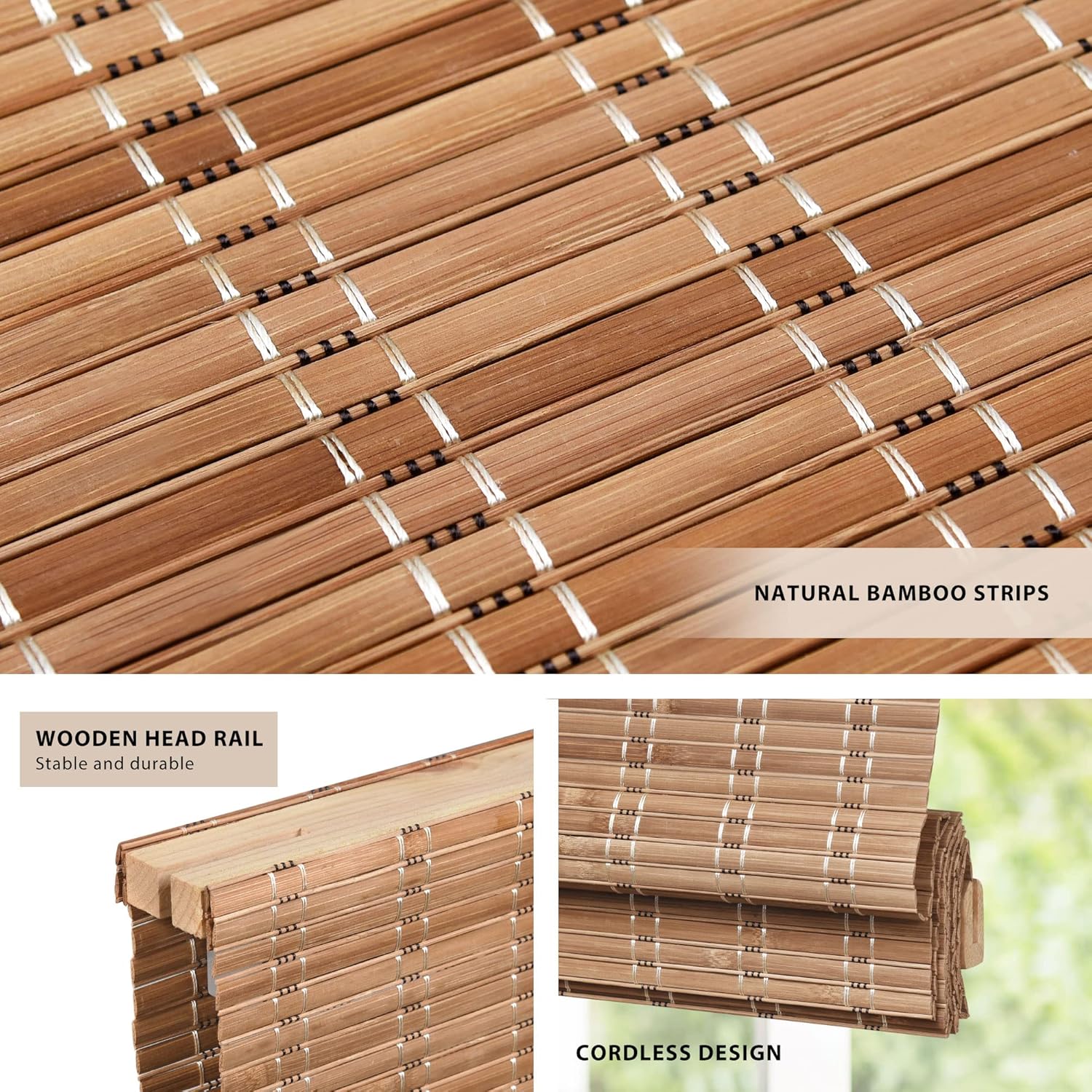
Bamboo shades are one of the most popular choices for softening a back wall of glass — and one of the most frequently mis-ordered. If you’ve landed here with a set of French doors or a sliding patio door in mind, you already know the basic appeal: the warm, woven texture of bamboo or matchstick material filters light beautifully and brings an organic quality that standard roller shades can’t replicate. What “bamboo shade” actually means in a product context is a window covering woven from natural grass, reed, or bamboo strips, sold in everything from $30 roll-ups to $400+ custom roman styles with a fabric liner. The challenge with doors — specifically French doors (two hinged panels that swing open) and patio doors (a fixed panel plus a sliding panel, or two sliding panels) — is that neither door type behaves like a wall-mounted window. The door moves. The shade, if attached incorrectly, moves with it in the wrong way, or gets pinched, or blocks the latch. This guide resolves the four decisions that trip up even experienced buyers: mount location, sizing math, swing clearance, and hardware choice.
The Core Problem: Doors Move, Windows Don’t
A standard window is static. You measure the opening, add or subtract for inside versus outside mount (more on that shortly), and order. A French door or patio door introduces a moving variable — literally. The shade can be mounted in one of three positions relative to the door:
- On the door itself (door-mount) — the shade travels with the door when it opens
- On the wall or casing above the door (wall-mount over the opening) — the shade stays fixed while the door swings beneath it
- On the door frame’s face (face-mount to the casing) — a hybrid that splits the difference
Each choice creates a different set of tradeoffs, and the right answer depends on how often the door is actually used. This Old House’s installation coverage consistently frames the decision around use frequency: a patio door used 20 times a day gets a different treatment than a set of French doors opened twice a week for backyard access.
Quick numbers to anchor the decision:
| Door type | Typical opening width | Typical clearance concern |
|---|---|---|
| Standard French door pair | 60″–72″ | 1.5″–2″ swing arc at panel edge |
| Single French door | 30″–36″ | Same arc, half the visual weight |
| Sliding patio door | 72″–96″ | Shade must clear track by ≥ 1″ |
| Hinged patio door | 32″–36″ per panel | Treat like French door |
These are manufacturer-typical ranges, not guarantees — always measure your specific rough opening.
Mount-Type Decision: Door-Mount vs. Wall-Mount
Door-Mount (Shade Rides the Door)
This is the cleaner-looking option for French doors specifically. The shade mounts directly to the door panel — either inside the door’s glass perimeter frame (inside mount) or on the door’s face (outside mount against the door surface). When the door opens, the shade goes with it.
The upside: No gap between shade and glass. Better privacy. Better light control. The room looks finished whether the door is open or closed.
The tradeoffs, named explicitly:
- Hardware must work with door material. Most French doors have a wood casing or MDF panel surround around the glass. You need at least 1.5″ of flat surface depth for inside-mount brackets, or a solid face for outside-mount. Hollow-core doors require toggle anchors or specialty door-mount brackets — standard wood screws will pull out. Per Smith & Noble’s measuring and installation guide, they recommend confirming door panel depth before ordering any inside-mount woven shade.
- Latch clearance is non-negotiable. The door handle, lever, or knob projects into the space the shade occupies when raised. A shade stacked too low in its raised position will catch on the hardware. The practical fix: order a shade with a headrail (the top bar the shade rolls into) that sits above the latch height, and confirm the stacked height of your specific shade. Most woven bamboo roman shades in the 24″–30″ wide range stack to approximately 4″–6″ when fully raised; matchstick roll-up shades compress tighter, often 2″–3″.
- Shade width must account for pull clearance. A shade mounted inside the door frame needs to be narrower than the glass by at least 3/8″ on each side to operate freely without binding. If your glass insert is 22″ wide, order at most 21.25″.
Wall-Mount (Shade Stays Fixed)
For a sliding patio door, wall-mount is almost always the right call. The shade hangs from the wall or header above the full door opening, drops in front of the glass when closed, and stays put while the door slides beneath it. This also works for French doors that are opened frequently, where you don’t want the shade flopping around or the brackets taking daily torque stress.
The upside: Easier installation. Less hardware stress over time. Works with virtually any shade width. Allows you to cover the full opening — including fixed sidelites — with one or two shades rather than per-panel pieces.
The tradeoffs:
- You lose privacy and light control when the door is open. If the shade is raised, it’s raised — the open door exposes the full opening. If the shade is lowered over a closed door, opening the door means pushing the shade aside, which works passably for roman styles but is annoying with roll-ups.
- You need adequate wall or header space above the door. An outside-mount bamboo roman shade installed 3″ above the frame and extending 2″ past each side (standard practice for maximizing coverage and minimizing light bleed, per The Shade Store’s measuring instructions) requires a header with solid backing. Measure to confirm you’re hitting framing or use a 1×4 mounting board.
- For sliding patio doors, track clearance is critical. The shade must not hang so low in its raised position that it contacts the top of the door track or interferes with the sliding panel. Most installers reported on Houzz leave a minimum 1″ gap between the raised shade’s bottom and the top of the door track.
Sizing Math: The Numbers That Matter
This is where orders most commonly go wrong. Work through these in sequence.
For door-mount inside-mount bamboo shades:
- Measure the glass insert width (not the door width) at three points — top, middle, bottom — and use the narrowest measurement
- Deduct 3/8″ per side (3/4″ total) for bracket and operating clearance
- Confirm the shade height fits between the top of the glass and the latch hardware with room for stacked height
For door-mount outside-mount bamboo shades:
- Measure the door panel width — not the glass
- Add 1.5″–2″ per side overlap onto the door frame (not the wall) to cover the gap between glass and frame edge
- Height: from top of frame to desired drop point, typically just below the door handle
For wall-mount over full patio door openings:
- Width = rough opening width plus 4″–6″ total (2″–3″ per side) for outside-mount overlap
- Height = from mounting point to floor, minus 1/2″ clearance, OR to sill height if you want the shade to stop at sill level
- For sliding doors: confirm the fully raised shade clears the top track by at least 1″
Bob Vila’s bamboo blinds coverage notes that light bleed — the gap of unfiltered light visible at the shade’s edges — is a top complaint from buyers who ordered inside-mount shades without accounting for the required deduction. Going outside-mount on a door frame, even by 1.5″ per side, dramatically reduces bleed.
Hardware and Cord/Lift Mechanism Choices for Doors
Standard corded bamboo shades have a real problem on doors: the cord dangles and gets pinched in the door swing. This is a safety issue (especially with children) and a frustration issue for everyone. The practical hierarchy for door applications:
1. Cordless lift — The default recommendation for any door-mounted shade. The shade raises and lowers by pushing the bottom rail up or pulling it down. No cord to catch on the latch, no dangling hazard. Most retailers now offer cordless as standard in widths up to 48″; confirm availability above that width since some woven materials have mechanism limitations.
2. Continuous-loop cord or clutch system — A single loop cord rather than dangling pulls, looped through a tensioner mounted to the door frame or wall. Less elegant than cordless but workable. Apartment Therapy’s bamboo blind roundup consistently flags that continuous-loop systems are a meaningful upgrade over standard corded for high-traffic door applications.
3. Motorization — Increasingly available for woven wood and bamboo roman shades from Smith & Noble and The Shade Store in their custom tiers. For a patio door you pass through multiple times a day, motorized lift is a genuine quality-of-life upgrade. Budget $200–$600 in added cost per shade depending on motor type (battery versus hardwired) and retailer. Hardwired motors require an electrician if there’s no existing outlet or conduit above the door frame.
4. Spring-roller mechanism — Common in matchstick and rattan roll-up shades. Works fine on door-mount applications because the spring provides automatic retraction with no cords; just pull down to lower and release to raise. The tradeoff is you lose precise height control — it’s either down or up, with imprecise stops in between.
Decision Rules: If X, Then Y
If you’re staring at a current project and need to cut through the options, here’s the framework:
If the door is used daily and you want shade on the door panels themselves → Door-mount, cordless lift, inside mount if you have ≥1.5″ depth and no hollow core issues; otherwise outside-mount with 1.5″ overlap onto door frame.
If the door is used occasionally (deck access, spare room) and aesthetics are the priority → Door-mount is still fine; standard corded or continuous-loop acceptable given low cycle count.
If it’s a sliding patio door with a track → Wall-mount outside mount, full-width shade covering both panels, confirm 1″ minimum clearance above track in raised position.
If the door has young children in the household → Cordless lift only, no exceptions, regardless of mount type.
If you’re in the custom tier ($400+ per shade) and the door gets daily use → Motorized roman shade on wall-mount is worth pricing. The per-use cost math over five years — which is a reasonable lifespan for quality woven roman shades per The Shade Store’s warranty documentation — favors a motorized system that doesn’t put mechanical stress on cords or spring mechanisms.
If budget is under $100 and the fit-or-fail risk is real → Matchstick roll-up on a spring roller, outside-mounted to the door face, sized to the full door panel width. Accept the light bleed at the edges as the price of entry-level pricing. Upgrade later when the door’s use pattern is confirmed.
The goal in every case is the same: a shade that moves the way the door needs to move, covers what needs to be covered, and doesn’t turn every trip to the backyard into a wrestling match with hardware. Get the clearance math right before you order, confirm your mount surface can hold the bracket load, and choose a lift mechanism that matches how often the door actually gets used.