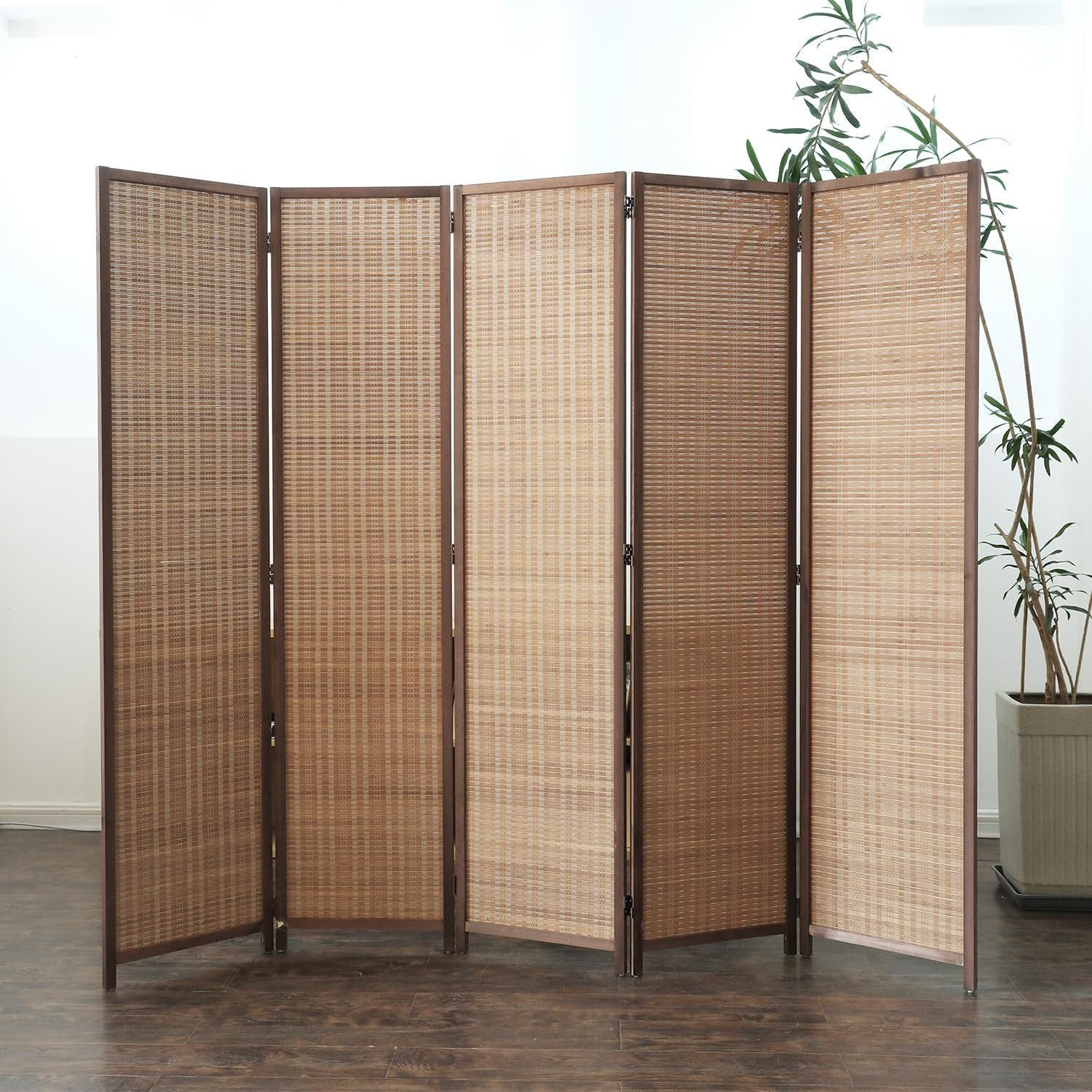
A room divider is exactly what it sounds like: a freestanding or semi-permanent panel — or a row of folding panels hinged together — that creates a visual boundary between two areas of a room. In open-plan homes and studio apartments, they’re one of the few tools that can conjure a “bedroom” from a living room corner, a home office from a dining alcove, or a dressing area from the foot of a bed — all without touching a single wall. Bamboo and other natural-fiber dividers (woven grass, rattan, shoji-style rice paper over wood frames) have become a particular sweet spot for design-minded buyers because they do double duty: they create the separation you need and add the organic warmth, texture, and light-filtering quality that flat drywall and hollow-core doors simply can’t deliver. This guide breaks down the real material and format tradeoffs so you can make a confident call — whether you’re sourcing a $90 studio fix or speccing a $600+ piece for a client’s primary suite.
| EDITOR'S PICK[Furnnylane 6 Panel Bamboo Room…](https://www.amazon.com/dp/B0B6HRH4WF?tag=greenflower20-20) | Mid-tierPartition Room Dividers | Budget pick[FDW Room Divider 4 Panel Room S…](https://www.amazon.com/dp/B0FT8PN1RJ?tag=greenflower20-20) | |
|---|---|---|---|
| Height | 67" | 67" | — |
| Width (Open) | 92.1" | 51" | — |
| Number of Panels | 6 | 4 | 4 |
| Shelves Included | ✗ | ✓ | ✓ |
| Price | $157.99 | $92.79 | $68.99 |
| See on Amazon → | See on Amazon → | See on Amazon → |
The Core Material Decision: What “Bamboo” Actually Means at Retail
The word “bamboo” covers a surprising range of products at retail, and the differences matter for durability, light behavior, and how well the piece holds up to repeated folding.
Solid bamboo slat panels are the most literal interpretation — thin strips of bamboo stalk, kiln-dried and lacquered, connected by cord or woven into a rigid grid. These are what most people picture. They’re dense, relatively heavy (a 4-panel screen in this construction can weigh 15–20 lbs), and they block a meaningful amount of light — though the gaps between slats will always let some through. The Spruce’s comparison of bamboo and rattan construction notes that solid bamboo’s hardness makes it more resistant to warping than rattan in humid climates, which matters if you’re placing a divider near a bathroom, kitchen, or an exterior wall with temperature swings.
Woven bamboo or matchstick panels are lighter and more pliable — essentially the same material you’d find in a bamboo roll-up window shade, but constructed into a freestanding frame. Light passes through more freely, giving a warm amber glow rather than a hard shadow line. These are the right choice when you want visual separation without a blackout effect. The tradeoff is acoustic transparency (you’ll hear everything on the other side) and somewhat less structural rigidity — a four-panel woven screen will wobble more than a solid-slat version.
Shoji-style frames use a wood lattice (usually pine, paulownia, or MDF at the lower price points) backed with translucent rice paper or a synthetic paper substitute. These are structurally distinct from bamboo but often shelved alongside it because the aesthetic overlap — warm neutrals, soft light diffusion, Japanese-influenced minimalism — is strong. Architectural Digest’s overview of natural dividers in modern interiors notes that shoji panels have the highest light-scatter quality of any freestanding divider, creating an almost glowing wall of diffused light rather than a pattern of shadow and highlight.
Rattan and seagrass woven frames are a fourth category that often gets lumped with bamboo in retail search results. Rattan is more flexible than bamboo, which makes it better suited to curved or shaped panels, but it’s more susceptible to humidity-driven loosening over time. Seagrass panels have a finer, more uniform texture than bamboo and read as slightly more contemporary in all-white or greige interiors.
Format Tradeoffs: Folding Screens vs. Modular Panels vs. Hanging Dividers
Once you’ve landed on a material direction, the structural format is the second major decision — and it’s where most buyers underestimate the constraints.
Traditional accordion-fold screens (typically 4–6 hinged panels, each panel 12–18 inches wide) are freestanding, require no installation, and can be repositioned. The catch: they’re only stable when angled into a slight zigzag. A fully extended straight line of panels will tip. If you’re configuring for a corner alcove or a U-shape around a seating area, the accordion format works naturally. If you need a flat partition across an open corridor, it fights you. Apartment Therapy’s roundup of room dividers consistently flags stability as the most common reader complaint about folding screens — specifically in households with pets or children.
Modular expandable panels solve the stability problem by adding feet or floor channels, but most bamboo-specific versions in this category are still at the lower price tier (under $150), and the feet hardware is often the first thing to fail. At the upper end, custom modular systems from specialty furniture retailers can be wall-anchored at the top — essentially a fixed partition — which is a fundamentally different product category with different installation requirements.
Ceiling-hung curtain systems with bamboo or woven-grass panels (the panels hang from a track mounted to the ceiling) are arguably the cleanest separation option for permanent studio configurations. They require installation (a ceiling track anchor, typically a toggle bolt in drywall or a screw into a joist) but they’re nearly invisible when open and genuinely effective as a visual barrier when closed. Houzz’s forum discussions on open-plan privacy solutions show this format getting strong marks from apartment dwellers who want flexibility without the visual bulk of a standing screen. The material in this format is almost always woven bamboo or matchstick — the weight of solid bamboo or shoji panels is too great for most residential ceiling tracks.
By the Numbers: Format and Price Ranges (2026 Retail)
| Format | Typical Panel Count | Price Range | Key Limitation |
|---|---|---|---|
| Accordion fold screen (bamboo slat) | 4–6 panels | $75–$350 | Requires zigzag angle to stand |
| Accordion fold screen (shoji) | 4–6 panels | $120–$500 | Rice paper tears; synthetic paper fades |
| Modular floor-anchored panels | 3–8 panels | $200–$800 | Hardware quality varies sharply |
| Ceiling-track woven bamboo | Custom length | $300–$1,200+ | Requires ceiling installation |
Sizing and Placement: The Mistakes That Show Up in Every Photo Critique
The most consistent issue in reader-submitted room photos — across forums and design community discussions — is dividers that are too short. A standard 6-foot folding screen in a room with 9-foot ceilings creates a visual gap that reads as an oversight rather than a design choice. The rule of thumb from Architectural Digest’s interior styling guidance: a divider should reach at least 80% of ceiling height to read as intentional architecture rather than furniture. For a 9-foot ceiling, that’s 7’2” minimum — and the majority of off-the-shelf bamboo screens top out at 6 feet.
Custom height is available from specialty retailers (Crate & Barrel’s room divider category and several Smith & Noble-adjacent custom workrooms offer made-to-order frames) but at a significant price premium. The more common mid-range solution is to pair a 6-foot screen with a continuous shelf or ledge at screen height, which creates a visual line that “reads” as the divider’s natural terminus.
Width math matters more than most buyers realize. A 4-panel screen where each panel is 14 inches wide gives you 56 inches of total span — barely enough to cover a standard doorway opening (typically 32–36 inches) with any overlap. For a freestanding room partition that spans a living room corridor, you’re typically looking at 6–8 panels to cover 7–10 feet of space in the zigzag configuration. Dwell’s coverage of small-space design notes that the optical effect of natural-fiber dividers depends significantly on the material being uninterrupted across the span — a single screen that doesn’t quite reach the wall reads as furniture; one that does reads as a wall.
Sourcing Strategy by Budget and Use Case
Under $150 (studio apartment, first-time divider buyer): Accordion bamboo slat or woven screens in this range are widely available through major retailers and function well as visual dividers in low-traffic configurations. The hardware at this price point — hinges, feet, cord connections — is the likeliest failure point, so reviews that specifically mention hinge durability after 6–12 months of use are the most useful signal. Apartment Therapy’s editors note that buyers in this tier consistently report satisfaction with the aesthetic but frustration with stability over time.
$150–$500 (homeowner, main-room application): This is where you start getting solid-frame construction with more reliable hardware, and where shoji-style panels become a viable option for design-conscious buyers. The Spruce’s product coverage in this range highlights that material consistency (uniform slat color, even weave, no visible cord joins) improves significantly around the $250–$350 mark. At this tier, look for screens with rubberized feet and double-hinged panels — these hold the zigzag configuration more securely.
$500–$1,200+ (designer, client project, permanent installation): At this level, the format usually shifts from off-the-shelf accordion screen to either custom modular panels or ceiling-track systems. The value of custom work here isn’t just aesthetics — it’s the ability to spec exact height, panel width, and material weight for the specific room. Ceiling-track bamboo systems in this range are durable enough for commercial-use durability standards, which matters in high-traffic residential settings (a home with children and pets is not a low-traffic environment).
If X, Then Y: The Decision Framework
This is where the tradeoffs compress into actionable rules:
If you need true acoustic separation (a sleeping area, a home office on calls), a bamboo or woven-grass divider will disappoint you — these materials are visually opaque but acoustically transparent. A solid-panel modular system with MDF or medium-density fiberboard core is the right product category; bamboo is the wrong tool.
If you’re in a rental and can’t touch walls or ceiling, freestanding accordion screens are your only option — but size up on height (look for 72”+ panels) and width (6 panels minimum for any span over 5 feet). Accept the stability tradeoff and position against furniture to brace.
If light quality matters as much as privacy (sunroom home office, bedroom reading nook), woven bamboo or shoji panels are the clear choice over solid slat. The light-scatter effect is a feature, not a compromise.
If you’re speccing for a client project and durability over 5+ years is a requirement, ceiling-track systems with solid frame woven panels outperform freestanding screens on every metric except installation cost. Budget the installation labor into the project quote — a ceiling track that fails because it was toggle-bolted into hollow drywall is a callback you don’t want.
If the room has humidity swings (a three-season porch, a bathroom-adjacent dressing room), solid bamboo resists warping better than rattan; synthetic-paper shoji holds better than rice-paper shoji. The Spruce’s material comparison notes that kiln-dried bamboo maintains dimensional stability across the widest humidity range of any natural-fiber divider material currently at retail.
The through-line: bamboo and natural-fiber dividers earn their place in a room when the brief calls for warmth, texture, and visual separation — not acoustic isolation, not structural permanence. Know which brief you’re actually solving before you commit to the material.